Why Agora
“Thanks be to God that, though you were slaves of sin, you became obedient from the heart to that form of teaching to which you were committed, and having been freed from sin, you became slaves of righteousness” (Romans 6:17,18).
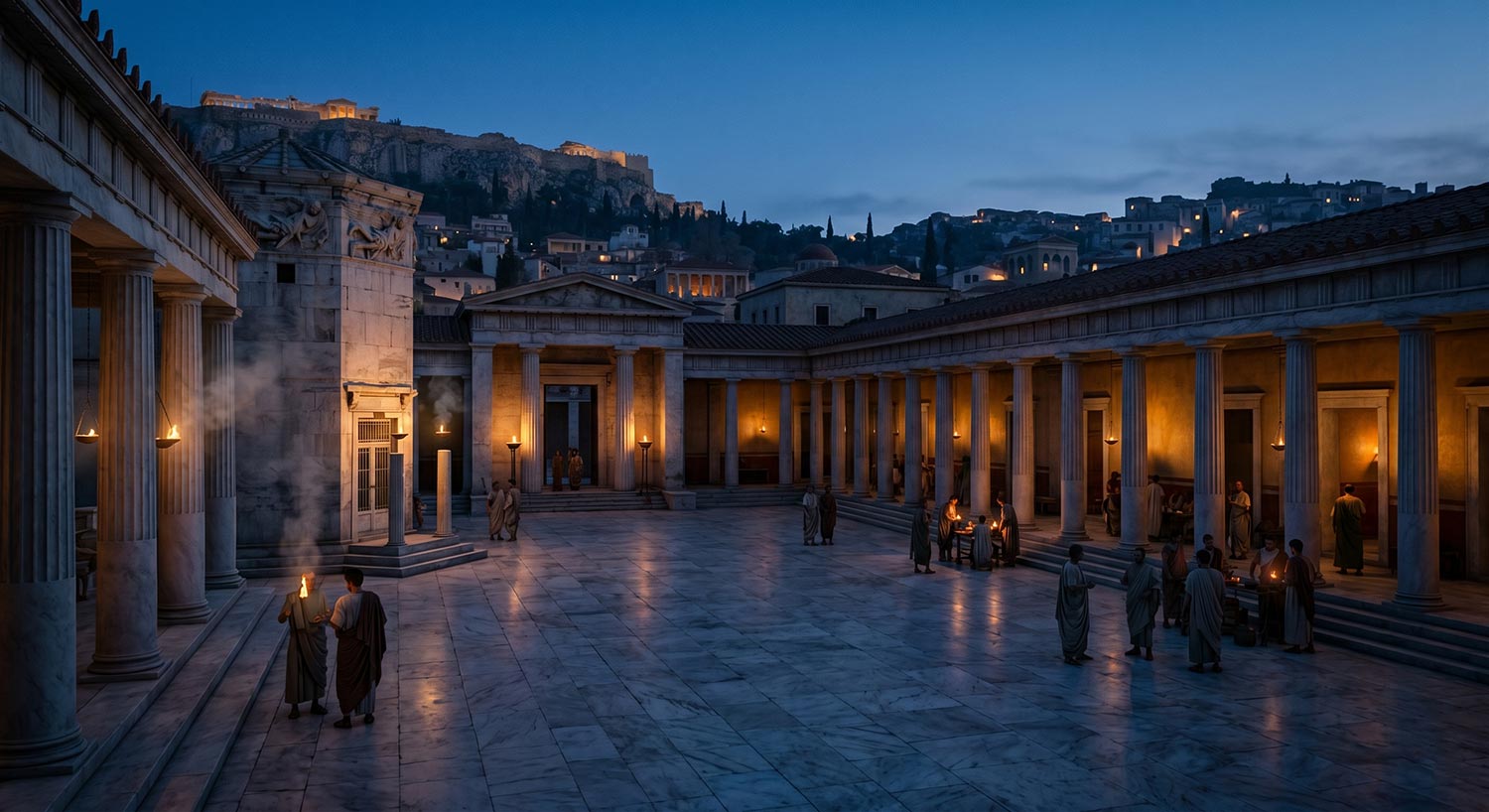
In the Greek of the New Testament, “agora” was the marketplace. It was also the place of public assembly, where people met one another and where children played. It was the place where news was circulated and ideas were exchanged. And especially, it was the place where the gospel of Christ was first preached.
Here the apostle Paul began to develop what we may call the “marketplace” or “agora” metaphor.
In the verses above, “sin” is personified: “Sin” becomes the great ruler to whom all the world gives allegiance, a slave-owner who owns all men and women. “I am unspiritual, sold as a slave to sin” (Rom 7:14). In this metaphor Paul is recalling the words of Jesus:
“Everyone who sins is a slave to sin” (John 8:34).
This figure of speech may come into focus as we imagine an eastern “agora,” or forum, or bazaar. This marketplace was the meeting place of the ancient world. It was the center of commerce, entertainment, and social interaction. And, as we said, it was also the source of news and opinions.
And always there, in the center of the “agora” was the slave-market, with its auction block. Approach that site in your mind, and the brutality, the callousness, and the fear wash over you like a flood. We imagine the smells and the sounds with revulsion, and our memories are stirred in like manner as when we see the old newsreels of Auschwitz, for our modern times have also seen their own particularly ugly forms of slavery.
Here we see women destined to be slaves to the worst desires of men. And other men, doomed to lifelong drudgery to satisfy the greed of their fellowmen.
Here are wasted, broken lives, dashed hopes, and families torn apart forever.
The slave-market may be an ugly parable of our world, where people are fleshly, carnal, unspiritual, and bought and sold as slaves to sin. Everyone who sins is a slave to sin. I sin; therefore I am a slave. And now we imagine being such a slave.
Into this scene comes a man who is obviously different from all others. Striding up to me, he speaks forcefully: “I have bought you; come, follow me.” There are no chains, no threats, no whips, just a simple command. And I follow him.
Right behind him, breathing fresh air, I walk through the milling and clamorous crowds, and then through the winding streets of the city, until we come to a beautiful house.
“Here is where I live,” my new master tells me. “And here is your room.” It is lovely and wonderfully furnished. Never have I seen such a luxurious dwelling, and this will be my home.
The master excuses himself, but soon he is back. He has brought water, and he kneels to wash my feet. I should be washing his feet. And he has brought me a new expensive garment. I can throw away my slave’s rags; I won’t need them any more. With healing oil he soothes the cruel wounds inflicted by my previous owner, and I know that they will never hurt again.
“Now you are as I am,” he says; “you are no longer a slave. This is my Father’s house, and you are one of His children!”
A lifetime of fear and hate is washed away, miraculously, and in its place is the cry of a heart set free:
“Because you are children, God sent the Spirit of his Son into our hearts, the Spirit who calls out, ‘Abba, Father.’ So you are no longer a slave, but a son; and since you are a son, God has made you also an heir” (Gal 4:6,7).
Redemption from the slave-market was a concept that would particularly appeal to Paul’s converts, many of whom had been slaves themselves (Titus 2:9,10). They might not be able to hope for redemption from their mortal bondage, but they could rejoice in being redeemed from Sin: “He who was a slave when he was called by the Lord is the Lord’s freedman” (1 Cor 7:22). And they could live accordingly. In their hearts and minds they were already free from the worst slave-master. And soon their bodies would follow, and they would be truly and absolutely free.
Redemption is release for a ransom. All who become God’s servants are therefore released from a former owner by purchase. The purchaser is the Lord God; and the price, or ransom, which had been paid, was the precious blood of His only Son, Jesus Christ.
The man who bought me had paid an unbelievable price. He had deliberately laid down his life, suffering and shedding his blood along the way, to purchase my release. And somehow I knew that “King Sin” had been destroyed, and would never torment me again.
In my mind, I heard: “The wages of sin is death, but the gift of God is eternal life.” Somewhere nearby, as I followed my Master beside green pastures, I heard another soft voice: “Do not be afraid, little flock, for your Father has been pleased to give you the kingdom.” And I knew, without being told, that my days of fear and starvation and illness and darkness were gone forever. And a new world was dawning on the horizon.
George Booker